Skip to content
56North

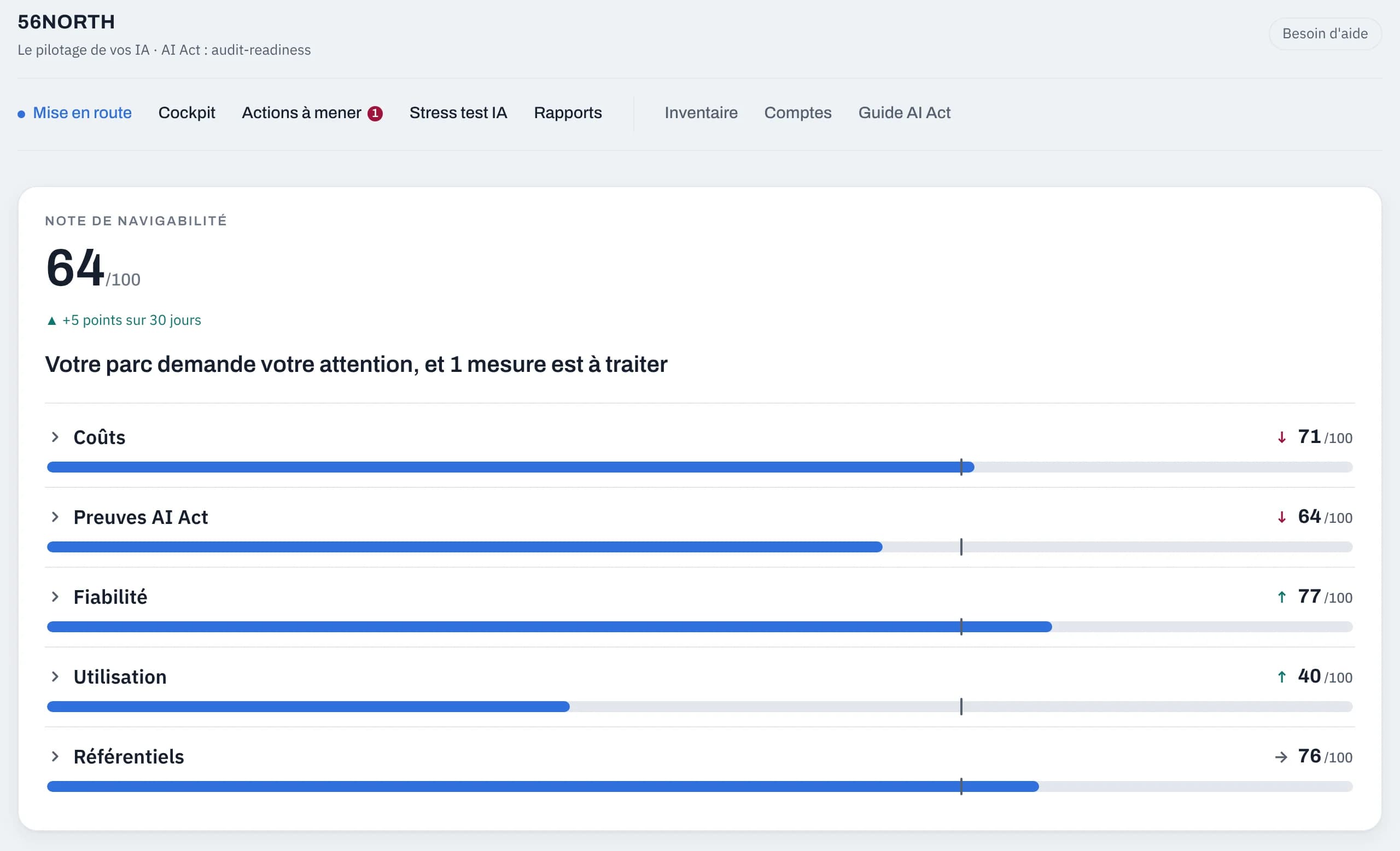
Airworthiness score

64out of 100

+5 points over 30 days

  • Costs71
  • AI Act evidence64
  • Reliability77
  • Usage40
  • Reference sources76
Example score. The scope always comes with the score.

In one sentence

56North is the system of record for a company's AI: a third party that inventories, measures and proves the behaviour of every one of its AI systems, whatever the vendor, and that sells no model, no integration and no cloud.

Why a third party

Why native tools are not enough.

Every major vendor now ships its own control tower: a screen that lists its agents, logs their actions and displays compliance indicators. These tools are useful. They do not answer the question a regulator will ask you.

  1. 1

    The vendor's compliance is not yours

    The EU regulation separates the provider, who designs the AI, from the deployer, who uses it in its operations. The vendor answers for its product. You answer for how you use it: human oversight, input data, informing the people concerned, keeping the logs (Article 26) and, for certain uses, the information Article 50 requires (emotion recognition, generated or manipulated content). No vendor tool carries these obligations on your behalf.

  2. 2

    Each control tower sees only its own ecosystem

    A mid-sized company now runs the AI in its CRM, the one in its office suite, the one in its ERP and the one in its ticketing tool. Four vendors, four control towers, four definitions of compliance. None of them sees the other three. You need one AI register, and one score for your audit committee.

  3. 3

    Whoever sells the AI cannot grade it

    A vendor that evaluates its own agents is judge and party. That is not an accusation, it is a position: its governance tool exists to reassure you about its product. A regulator, an insurer or a large client will ask who, outside the vendor, has checked.

  4. 4

    Evidence is judged by how it holds up over time

    A dashboard shows the state of today. Evidence shows what was true on a given date, who established it, and guarantees that no one has altered it since. Native tools are built for the first use. 56North is built for the second.

Native tools remain necessary: they govern each AI from the inside. 56North sits above them, on the company's side, and consolidates what they produce into one registry, one score, one evidence file.

Sound familiar?

  • New AI features appear with every software update, and nobody has declared them.
  • Each vendor shows you its own dashboard; none shows you the whole picture.
  • Your audit committee asks who is accountable for AI, and nobody raises a hand.
  • The evidence may exist, scattered across emails and shared folders.
What changes with 56North

  • A complete list of your AI systems, each with a named owner.
  • A score per system and a company score your executive committee reads in two minutes.
  • A sealed inspection file, ready the day an auditor asks for it.
  • The cost of your AI, tracked month after month.
  • Every model change spotted, dated and sealed.

The regulatory clock

The calendar is not negotiable.

The EU AI Act applies in stages. Past deadlines are already enforceable; the next ones need preparing now, because an inspector will ask for dated evidence.

  1. 2 February 2025Prohibited practicesEnforceable
  2. 2 August 2025General-purpose AI modelsEnforceable
  3. 2 August 2026Transparency: telling people they are dealing with an AI. Penalties apply.Enforceable
  4. 2 December 2027High risk: recruitment, credit, education, biometricsPrepare now
  5. 2 August 2028AI built into products that are already regulatedUpcoming

Penalties of up to €15M or 3% of worldwide turnover for deployer obligations, €35M or 7% for prohibited practices.

The problem

Six questions, and nobody to answer them.

The ones an executive team asks as soon as AI enters day-to-day operations.

  1. 1

    Which AI systems do we have?

    Including the ones nobody declared: individual accounts, features switched on by a software update.

  2. 2

    Who is accountable?

    A named person. It is the first thing an inspector asks for, and rarely what they find.

  3. 3

    What do they do?

    On which cases, how often, for how many people. And who actually uses them.

  4. 4

    What risk do they create?

    The risk class depends on the use: screening applications and summarising a meeting carry different obligations.

  5. 5

    Do they follow your rules, and the law?

    Two different deviations: the AI that does what you forbade, and the AI that puts you outside the law. Both are often found too late.

  6. 6

    Can we prove it?

    At an inspection, good intentions are not enough: you need dated evidence, with the name of who produced it.

What is at stake

An unproven deviation is a hidden liability.

This is not only a compliance topic. It is a board topic.

Errors and lawsuits

Deloitte refunded part of a report's fee to the Australian government. Air Canada was ordered to compensate a customer misled by its agent. And one public deviation makes your customers doubt.

Drifting spend

AI subscriptions and calls nobody adds up: the real cost shows at year-end close, too late to act.

Valuation

At every fundraise or sale, the buyer discounts what it cannot verify: price cut, liability warranty.

Fines

Up to 3% of global turnover for deployer obligations (AI Act), 4% (GDPR), 7% for a prohibited practice.

Proving your AI is under control protects the value of the company.

What we do

Control, prove, operate.

Software alone proves nothing. You also need people who test, and a team at the helm. The three components can be bought separately and work together.

01Available

The software

The Cockpit

The registry of your AI systems, their risk class over time, the regulatory timeline, the evidence vault, the five-dial score, model change detection and the monthly flight report. One platform, whatever your vendors.

02Activated on engagement

Prove, with our partners

Human in the Loop

Trained people put your AI systems to the test and review their answers: bias, hallucinations, data leaks, procedures not followed. Their findings enter the Cockpit as dated evidence, with their author.

03Set up with a subscription

Operate, with our partners

Factory

An AI engineering team that connects your existing systems to the Cockpit, keeps them running in production, monitors them and produces the report. The equivalent of a security operations centre, for AI governance.

Three ways to start

To start

A fixed-price assessment

A map of your AI systems, their classification, and what would be missing in front of an inspector.

One domain at a time

Sprints by domain

Human resources, customer relations, finance: one domain after another. The score is always calculated by the machine, never promised.

Ongoing

A governance subscription

Continuous measurement, testing campaigns, monthly flight report.

Request an assessment

A free 30-minute first conversation, no commitment.

The Cockpit

Far more than the law: five dials, five risks.

Compliance is only one dial out of five. The other four tell you whether your AI works, what it costs, whether it is used and what it relies on. A published method, identical for every client.

The Cockpit steering screen: the airworthiness score out of 100 and the five dials
The Cockpit steering screen. Example fleet.
  • Reliability

    The quality of the answers, assessed on your real conversations.

    If nobody is watching

    Wrong answers given to your customers or staff, and nobody notices.

  • Costs

    The cost per case handled, and its trend.

    If nobody is watching

    A bill that drifts month after month, discovered at year-end close.

  • Usage

    Who actually uses each AI system.

    If nobody is watching

    Licences paid for nothing, and uses nobody authorised.

  • Reference sources

    How fresh the knowledge your AI systems rely on is.

    If nobody is watching

    An AI answering with outdated prices, procedures or rules.

  • AI Act evidence

    The registry, the evidence, the deadlines that apply.

    If nobody is watching

    A fine, and a decision you cannot defend.

A score from 0 to 100, a grade from A to E, a 30-day trend.

Up and running in three steps

  1. 1

    Declare

    A few questions per AI system, and the registry fills itself.

  2. 2

    Connect

    One address and one key to change in the software.

  3. 3

    Measure

    The dials light up with the first calls.

Every month, the flight report is frozen when published and sealed with a fingerprint that shows it has not been altered since.

Human in the Loop

People who test your AI. Not the vendor who sells it.

A vendor cannot judge its own biases. With our partner Isahit, a French data-annotation company, trained people put your AI systems to the test and review their answers, and every finding becomes dated evidence in the Cockpit.

Activated on engagement, with our partner Isahit

Partner: Isahit ↗

The first European ethical-AI company certified B Corp: 1,000+ annotators, 7,500+ projects, references such as Airbus, Orange and L'Oréal.

What the offer covers

  • Black-box testing campaigns

    Bias, hallucinations, data leaks, procedures not followed: scenarios written for your use cases, run against your AI systems as they actually run.

  • Two independent reviewers, blind

    Each case is judged by two independent people, without first seeing the AI's answer. When they disagree, a third opinion decides.

  • Review of real conversations

    Samples reviewed by people residing in the European Union, in teams formed for each client to our requirements, within the scope set in the purchase order.

  • Test sets for your agents

    Building and annotating the scenarios that then serve as your regression tests.

Every finding enters the Cockpit as dated evidence, with its author: what an inspector accepts, and what no vendor tool can produce about its own AI.

Factory

Connect, maintain and run the AI you already have.

Most of a company's AI is already in place, across several vendors. With our partner Wikolabs, the Factory connects it to the Cockpit, keeps it reliable in production and spares you from building a dedicated team.

Set up with a subscription, with our partner Wikolabs

Partner: Wikolabs

Agents on open-weight models, installed on your premises and connected to your ERP, CRM and databases. A six-step method, with a demo at every sprint and your sign-off on each deliverable.

What the Factory takes on

  • Connect

    Plugging your AI systems into the Cockpit: gateway, logs, then vendor connectors as they become available. You move from the “declared” to the “connected” level.

  • Maintain

    Tests replayed after every vendor release, knowledge sources kept up to date, access rights reviewed, costs tracked.

  • Monitor and alert

    Drift is detected and reported before a customer, an employee or an inspector finds it.

  • Produce the report

    The monthly flight report, prepared by the Factory and published by a person.

Vendor-neutral: the Factory runs systems from every vendor, and everything it maintains is overseen in the Cockpit with sealed evidence any third party can verify.

Sovereignty and security

Sovereign and secure, by design.

Your AI systems produce logs. The Cockpit reads them in your dedicated instance and turns them into sealed evidence. Entrusting this oversight to a tool that depends on a foreign giant would make no sense.

Hosting
With Scaleway, a French provider, in its Paris data centre.
Software
Built on auditable open-source components, with no proprietary lock-in.
Evaluation model
Mistral, a European model hosted in the EU.
Data
One instance and one database per client, never shared. User identities pseudonymised on arrival, irreversibly.
Evidence
Reports and evidence sealed with a fingerprint: any edit shows. Defined retention periods, daily backups.
Switch
If your calls go through our gateway, its master key stays with you. 56North cannot shut anything down.

Two deployment modes

SaaS

Hosted by 56North

A dedicated instance. Quick start, updates included.

On-premise

Installed at your site

For regulated sectors. Installation led by our team.

The same scoring method in both cases.

How we build

We hold ourselves to what we measure in your company.

A trusted third party is also judged by how it builds its own tool.

lines of code in service, excluding tests
75,000+
automated tests passing on every release
3,500+
dated, reasoned decisions, never erased
420+
read-only technical audit
4 Sept 2026

Method first

Written, published, then frozen during pilots. No scale is ever adjusted to suit a client.

Traceability

A numbered register: the date, the decision, the reason. We demand of ourselves what we demand of your AI systems.

Lasting security

Every fix comes with a guard test that stops the problem from coming back.

Transparent measurement

What can be measured is measured automatically; what rests on a declaration is flagged as such.

No empty promises

A feature only appears on this site once it has shipped.

Isolated data

One instance per client, a daily backup and a weekly copy.

What binds us

Independent by principle. Sovereign by design.

The one who measures sells nothing else

No models, no integration, no cloud. Whoever builds your AI systems cannot grade them.

Your data stays with a French provider

Scaleway hosting, open-source components, a European evaluation model. Two technical subcontractors, no more.

A published method, never tweaked

Written, versioned, identical for all. Partners may sell it; the calculation, the sealing and the thresholds stay with us.

Evidence, never a certificate

We prepare your file so it is ready the day someone asks for it. We never call it a certification.

Pascal Mennesson

Who is behind it

Founded by someone who grew a team of more than 1,000 consultants.

56North was founded by Pascal Mennesson, founder of Maltem Consulting Group, which he grew from 2001 to more than 1,000 consultants in 12 countries before its exit. It starts from a simple observation: companies adopt AI faster than they learn to govern it.

LinkedIn ↗

Questions

What people ask us.

Is the first conversation free?

Yes. The 30-minute first conversation is free and comes with no commitment. You leave with a first map of your known AI systems and likely gaps, and we tell you plainly whether further work is worth it.

What is an AI registry?

The list of every AI system a company uses, each with its purpose, its owner, its risk class under the EU AI Act and the related evidence. It is the starting point of any AI governance.

How is this different from the vendors' compliance tools?

Each vendor proves the compliance of its own tool. 56North sits on the side of the company that deploys AI, and consolidates its whole estate, whatever the supplier.

Is this an AI Act certification?

No. We prepare an evidence file ready for an inspection. The scope covers the obligations of a company that deploys AI systems, in particular articles 4, 26, 27 and 50 of the EU regulation.

Can we buy just one component?

Yes: the Cockpit alone, Human in the Loop campaigns alone, or the Factory to run your systems. They work best together, but nothing forces you to take everything.

Can the Cockpit shut down our services?

No. If your calls go through our gateway, its master key stays with you: only you hold the switch.

Can we install the Cockpit ourselves?

Yes. As SaaS, on a dedicated instance, or on-premise, in your own infrastructure. The method and the score are strictly identical.

What about the AI built into our software suite, which we cannot connect?

It enters the registry, is classified and receives its evidence. The regulation asks you to govern it, not necessarily to measure it. The score always states the scope it covers.

Who sees our data during testing?

Bias detection runs on fabricated scenarios, with none of your data. Reviewing real conversations is reserved for auditors residing in the EU, and specified in the purchase order.

We are not in the European Union. Does this apply to us?

Probably, if you have subsidiaries, customers or job applicants in the EU. And beyond the regulation, the question remains: do your AI systems do what you think they do?

Free first conversation

Thirty minutes is enough to know whether this is for you.

We review the AI systems you know about, spot the blind spots and leave you with a first map: your known AI systems and the likely gaps. If the timing is not right, we will tell you.

1 of 4

Roughly how many AI systems do you use?

An estimate is enough. Include the AI features in your software.

Free 30-minute first conversation. Reply within two working days. Your details are used to arrange this conversation and nothing else. See our privacy policy